
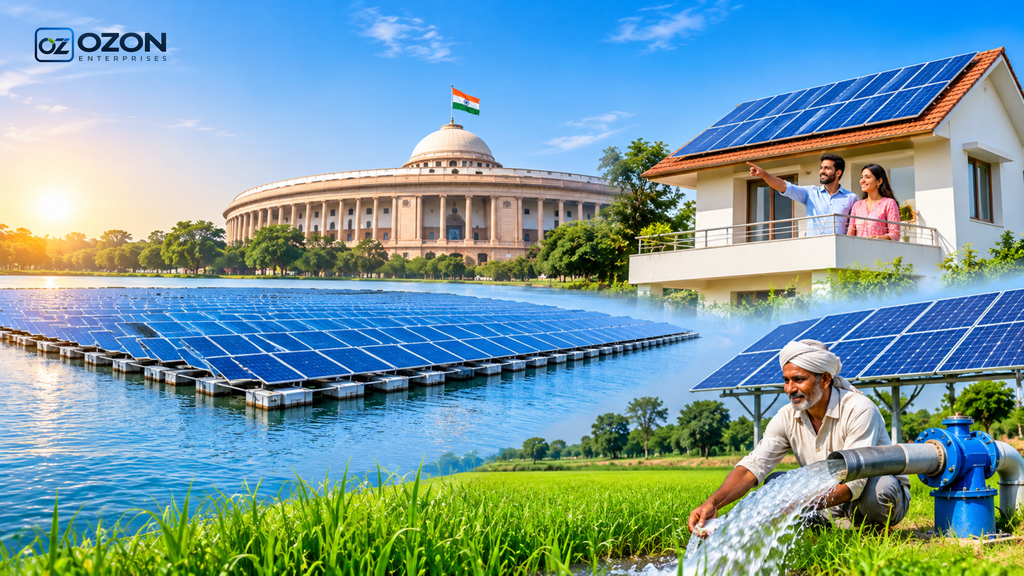
India is entering an exciting new phase of clean energy development. With rising electricity demand, growing environmental concerns and increasing investment in renewable energy, solar power is becoming an important part of the country’s energy future. One technology gaining attention is floating solar power, which allows solar panels to generate electricity on reservoirs, lakes and other suitable water bodies.
India currently has around 700 MW of operational floating solar capacity, while the government’s new Pradhan Mantri Surya Sarovar Yojana (PM-SSY) aims to support an additional 5,000 MW (5 GW) of floating solar projects with energy storage. This development creates new opportunities for India’s renewable energy sector and strengthens the country’s clean energy ambitions.
But what does this growth mean for homeowners, businesses and the future of solar energy? Let’s explore.
What Is Floating Solar Power Technology?
Floating solar panels, also known as Floating Solar Photovoltaic (FSPV) systems, are solar modules installed on specially designed floating structures over water bodies. Instead of occupying agricultural or unused land, these systems use suitable reservoirs, lakes and industrial water ponds to generate renewable electricity.
A floating solar power plant generally includes solar PV modules, floating platforms, anchoring systems, electrical cables, inverters and monitoring equipment. The generated electricity is converted into usable power and supplied to the grid.
This technology offers an alternative way to expand solar power generation in India, especially where suitable land is limited.
India’s Floating Solar Capacity: From 700 MW to 5 GW
India’s floating solar sector is moving towards large-scale development. With approximately 700 MW of existing floating solar capacity, the government has introduced a major initiative to accelerate deployment.
The PM Surya Sarovar Yojana (PM-SSY) has an approved financial outlay of ₹5,070 crore and targets 5,000 MW of floating solar photovoltaic projects with co-located energy storage systems. The projects are planned for sanction during FY 2026–27 to FY 2030–31.
The programme also includes energy storage requirements, helping improve electricity supply and grid reliability. India’s estimated floating solar potential is approximately 102.18 GWp across suitable reservoirs and inland water bodies.
This investment could encourage infrastructure development, domestic solar manufacturing, energy storage technology and employment opportunities.
Major Benefits of Floating Solar Power Plants
Floating solar technology offers several advantages for India’s renewable energy industry.
1. Better Utilisation of Water Bodies: Floating solar systems use suitable reservoirs and industrial ponds, reducing the need for additional land.
2. Renewable Electricity Generation: These systems generate clean electricity and help reduce dependence on conventional fossil fuels.
3. Potential Cooling Benefits: Water can help moderate solar panel operating temperatures under suitable conditions, potentially improving system performance.
4. Reduced Land Competition: Floating solar projects can be useful in locations where large areas of suitable land are difficult to obtain.
5. Integration with Energy Storage: Combining floating solar with battery energy storage systems can support more reliable electricity supply.
However, project design must consider water conditions, anchoring, corrosion, maintenance, environmental impact and grid connectivity.
PM Surya Sarovar Yojana: Government’s 5 GW Floating Solar Initiative
The Pradhan Mantri Surya Sarovar Yojana (PM-SSY) is an important government initiative focused on developing floating solar photovoltaic projects with energy storage systems.
Its key objectives include:
- Supporting 5,000 MW of floating solar capacity.
- Encouraging energy storage integration.
- Promoting the use of existing reservoirs and industrial ponds.
- Supporting domestic manufacturing and renewable energy infrastructure.
- Improving electricity grid reliability.
The scheme provides central financial assistance for eligible floating solar projects after successful commissioning, subject to the applicable guidelines.
It is important to understand that PM-SSY focuses on large floating solar projects. It is different from the residential rooftop solar subsidy scheme.
PM Surya Ghar Muft Bijli Yojana: Rooftop Solar Benefits for Homeowners
While floating solar projects support large-scale renewable energy generation, homeowners can also participate in India’s solar transition through the PM Surya Ghar Muft Bijli Yojana.
This government scheme encourages eligible residential households to install grid-connected rooftop solar systems and offers Central Financial Assistance through the official national portal.
Under the published subsidy structure:
- ₹30,000 per kW for the first 2 kW.
- ₹18,000 per kW for the additional capacity up to 3 kW.
- Maximum standard central subsidy of ₹78,000 for eligible residential systems.
Actual assistance depends on eligibility, applicable scheme rules and approved installation requirements.
Homeowners searching for PM Surya Ghar subsidy, rooftop solar government schemes or solar panel installation assistance should check the official portal before making an investment.
Official website: https://pmsuryaghar.gov.in/
PM-KUSUM Scheme: Solar Energy Opportunities for Farmers
Another important government initiative is the PM-KUSUM Yojana, which promotes solar energy in agriculture. It supports eligible decentralised solar power plants, standalone solar agricultural pumps and solarisation of existing grid-connected agricultural pumps.
The scheme aims to help farmers access reliable solar-powered irrigation, reduce dependence on conventional electricity and support additional clean energy generation.
People searching for PM KUSUM solar pump subsidy, solar water pump installation and government solar schemes for farmers should review the latest eligibility conditions and state-level implementation guidelines.
Why Rooftop Solar Installation Is Growing in Maharashtra
Large-scale floating solar projects are transforming India’s renewable energy infrastructure, but rooftop solar is equally important for everyday electricity consumers.
In Maharashtra, homeowners, shops, offices, commercial buildings and industrial facilities are exploring rooftop solar panel installation to manage electricity expenses and make better use of available roof space.
A properly designed solar system can help generate electricity from sunlight, reduce grid electricity consumption and provide long-term energy benefits.
The right system depends on monthly electricity usage, available rooftop area, shadow conditions, electricity connection type, inverter selection and budget.
For residential properties, a 3 kW rooftop solar system may suit some households, while commercial and industrial properties may require larger systems after a technical assessment.
Solar Panel Installation in Kudus & Palghar, Maharashtra
If you are planning to switch to clean energy, choosing a suitable solar installation provider is an important step.
OZON ENTERPRISES provides solar energy solutions for residential, commercial and industrial requirements, serving customers in Kudus and Palghar, Maharashtra.
Our solar services focus on understanding electricity consumption, evaluating rooftop conditions and recommending suitable solar solutions according to individual requirements.
Our services include:
- Residential Solar Panel Installation for homes and independent houses.
- Commercial Solar Installation for shops, offices and business premises.
- Industrial Solar Solutions for eligible industrial properties.
- On-Grid Solar System Installation for grid-connected properties.
- Hybrid Solar System Installation with suitable battery storage.
- Solar Inverter and Battery Solutions for compatible solar applications.
- Solar System Inspection and Maintenance to support system performance.
- Solar Consultation and System Design based on electricity requirements.
- Net Metering Assistance and guidance on applicable installation procedures.
- PM Surya Ghar Scheme Guidance for eligible residential customers.
Whether you are searching for solar panel installation in Kudus & Palghar, a reliable solar installation company in Kudus & Palghar, or residential rooftop solar solutions near Mumbai, selecting the right system and professional installation approach can make a meaningful difference.
How to Choose the Right Solar Panel Installation Company
Before installing a rooftop solar system, consider these important factors:
- Check the quality and specifications of solar panels and inverters.
- Compare system capacity with your monthly electricity consumption.
- Evaluate rooftop space, orientation and shading.
- Ask about installation quality, safety and electrical protection.
- Understand warranty terms and after-installation support.
- Confirm applicable net metering procedures and government subsidy eligibility.
A professional solar consultation can help you understand your options before investing in a solar energy system.
The Future of Solar Energy in India
India’s journey from approximately 700 MW of floating solar capacity towards a 5 GW government-supported project pipeline highlights the growing importance of innovative renewable energy technology.
With floating solar projects, rooftop solar installations, agricultural solar pumps and battery energy storage, India is building a more diverse clean energy ecosystem.
Government initiatives such as PM-SSY, PM Surya Ghar and PM-KUSUM are supporting different areas of this transition. Together, they create opportunities for energy infrastructure, households, farmers and businesses.
For homeowners and businesses in Kudus and Palghar, adopting rooftop solar can be a practical step towards better energy management.
Frequently Asked Questions
1. What is floating solar power, and how does it work in India?
Floating solar power is a renewable energy technology in which solar panels are installed on floating platforms over reservoirs, lakes and other suitable water bodies to generate electricity without using large areas of land.
2. What is India’s 5 GW floating solar target under PM Surya Sarovar Yojana?
The Pradhan Mantri Surya Sarovar Yojana (PM-SSY) aims to support 5,000 MW of floating solar projects with integrated energy storage, helping expand India’s renewable energy infrastructure.
3. How can homeowners get solar panel subsidies under PM Surya Ghar Yojana?
Eligible residential households can apply for rooftop solar subsidies through the official PM Surya Ghar portal. The standard central subsidy can reach ₹78,000 for eligible systems of 3 kW or above, subject to scheme guidelines.
4. Is solar panel installation beneficial for homes and businesses in Kudus and Palghar?
Yes. A properly designed rooftop solar system can help homes, shops and commercial properties in Kudus and Palghar generate electricity, reduce grid consumption and manage long-term electricity expenses.
5. How can I choose the best solar panel installation company in Palghar?
Compare solar panel and inverter quality, system design, installation standards, warranty, net metering assistance and after-sales support. OZON ENTERPRISES provides solar consultation and installation solutions for residential, commercial and industrial requirements in Kudus and Palghar.
Looking for Solar Panel Installation in Kudus & Palghar?
Ready to explore solar energy for your home, shop or commercial property?
OZON ENTERPRISES helps customers explore suitable solar panel installation solutions in Kudus and Palghar, Maharashtra. Get in touch for a solar consultation and find a system that matches your electricity needs.
Contact OZON ENTERPRISES today and take your first step towards smarter, cleaner solar energy.